BFoM’s July 2019 petition includes background and history to explain where the BSD’s music program has been, what BFoM has been doing to advocate, and how that relates to what’s happening right now. The following expands on those points for those who wish to have a deeper understanding. We’re constantly learning about school policies, so please let us know if there’s anything we missed.
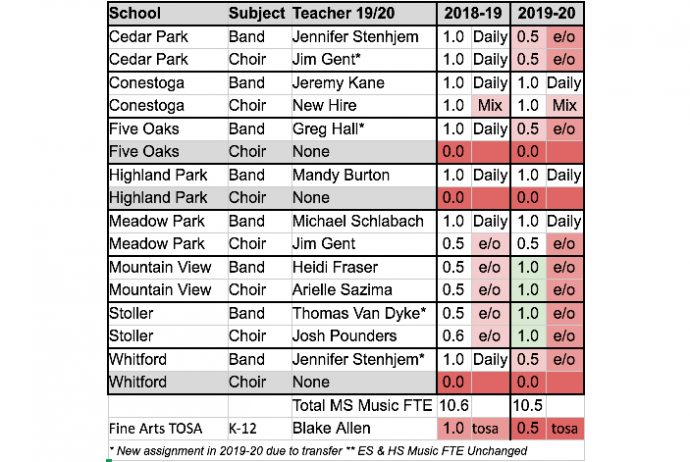
To start things off, let’s take a look at where our middle and high school programs stand now in terms of staffing and scheduling. Here we can see that most band programs met daily last year, but the majority will now meet every other day, even in cases where the band director position was just increased. Three band programs and one choir program that were meeting daily last year will now meet every-other-day, and there are only three band programs left that meet daily with a full-time director. Three schools still have absolutely no choir curriculum offered at all (highlighted in bright red). Four directors were transferred this summer due to the changes in allocation at each site, yet the overall FTE dedicated to music remains basically flat:

Key: 1.0 = one full-time teaching position • 0.5 = one half-time position • “Daily” = students attend the class every day • “e/o” = students attend class every-other-day
1. BSD Funding for Curricular Programs
BSD has two systems for funding curricular programs in schools: Centrally-allocated and Site-based. The district budget provides some details in the SAM (“Staffing Allocation Methodology”) section of the budget.
- Centrally-allocated staffing means central office administrators determine the service level that should be offered and then allocate the appropriate number of staff positions to provide that service level at each school. Some of these programs have their own line-item in the district budget, such as “Specialists” (i.e. Music & PE) on the SAM for Elementary Schools.
- Site-based staffing means each school starts with a lump sum of general staffing funds. In conference with staff committees on class size and scheduling, the principal at each site decides how the funds should be split between each subject and how the subjects should be scheduled (class length & frequency). Changes in site-based positions are harder to track within the district budget because the decisions are made at the building level, sometimes after the budget is passed.
BSD elementary schools are centrally-allocated for music (and PE, and most other major programs). Each elementary and K-8 school is allocated 1.0 FTE music teacher for 18 homeroom classes, 1.5 FTE for 19-24 classes, 2.0 FTE for 25-35 classes, and 2.5 for 36+ classes. The same model is used for PE classes. The formula moves in concert with the Certified Collective Bargaining Agreement which entitles elementary homeroom teachers to 675 minutes average weekly plan time. It is straightforward and fair, requiring principals to schedule all elementary students for minimum of 90 minutes of music and 90 minutes of PE every 5 to 6 school days no matter which of the 34 elementary/K-8 schools they attend.
Note: General staffing for elementary homeroom teachers is also centrally-allocated based on the district’s student-to-teacher ratio for the budget year; it provides a lump-sum number of classroom positions and each school’s Class Size Committee determines how many sections of each grade level there will be that year. In this way, principals and staff still have some flexibility with their schedule and class sizes, but music and PE curriculum remain guaranteed at 90 minutes per week.
BSD middle and high schools use the site-based model for staffing music and almost all other programs. The SAM provides a lump-sum number of teaching positions based on the district’s student-to-teacher ratio for the budget year, and the principal (in conference with staff committees on Class Size and Scheduling) decides how much or how little of each subject will be supported in their particular school. That is why the offerings often look different from school to school, sometimes varying widely.
Note: There are certain programs at the secondary level that are centrally-allocated and have their own line-item on the SAM. AVID and Intervention are two examples. ELL and Special Eduction (a.k.a. “Resource Room”) programs are also centrally-allocated for both elementary and secondary levels; they have a dedicated page in the district budget. BSD has centralized policies dictating the level of service and frequency of access students should have to those programs. The district tracks student enrollment in these programs to predict the level of staffing that will be needed for each program at each school.
2. Who Decides about Curricular Programming
During this year’s budget process, specific program reductions were outlined by the district in order to balance the budget. The cuts touched many areas including central office TOSAs, but the district did not announce which categories of TOSAs would be reduced during the budget process. In that regard, the cut to our Fine Arts TOSA position, while disappointing, is not a complete surprise, but rather somewhat a surprise. The PE TOSA was also cut to half-time FTE this summer, but that was expected since half the position had been funded by an expiring grant.
A few of the other major areas listed for reduction in the 2019-20 budget were ELL & Title I (adjusting for enrollment), Intervention, and the Primary Years Program. Some of the cut Intervention positions were at the middle school level, and somewhere between losing the Intervention positions and making building decisions about scheduling and class size, the cuts ended up unexpectedly falling to electives programs including music. This part is a complete surprise. We heard there were also unexpected cuts to some middle school Spanish and drama courses. There may be other courses affected that we haven’t heard about yet.
Building principals made the decisions in this case, but BFoM does not believe building principals hold all of the responsibility. There is a problem with our district’s system for programming middle school curriculum. Schedules and course offerings at our eight neighborhood middle schools have varied considerably for years, with no sense of vision for ensuring equitable opportunities to learn. This causes issues for student experience with K-12 music education as well as other subjects that require sequential instruction over time. The target of our advocacy needs to be both principals in charge of steering their building and the higher levels of administration who have the power to fix the systemic part of the problem.
3. BSD Music Task Force of 2014 and Initial Progress
Part of the reason this summer’s situation is so frustrating is the Board and administration have been aware of the issues, and they could have been successfully addressed long ago if only it had been made a priority. We feel confident that it isn’t so much a budget issue as it is a philosophical/structural issue. Our coalition successfully provided unified support for the district to create a Music Task Force in 2014 and begin to implement its recommendations. Unfortunately, the district stopped implementing those recommendations shortly after elementary music was restored and our Music TOSA (now Fine Arts TOSA) was hired. As promised, some bond funds were distributed to middle and high school band and choir programs for materials and equipment. Along the way, middle and high school principals increased or maintained music staffing according their own timing and building-level priorities. That all represented progress compared to where things were after the sweeping music cuts of 2012, but representation of music courses in the middle school schedules remained spotty and lop-sided. BFoM was keeping an eye on that situation and listening for ways we could help when a couple of new complications came onto the scene.
4. A Surprise Music Cut at Mountain View in 2015
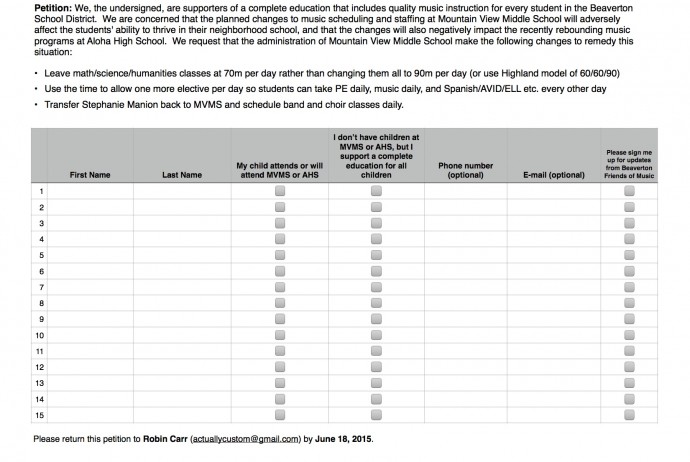
In 2015, the outgoing principal at Mountain View Middle School unexpectedly cut the school’s daily band and choir program in half and the band director was involuntarily transferred to another school. PE became a daily class, math/science/humanities courses were lengthened from 70 to 90 minutes per day, and a Spanish elective option was added. The cut in music FTE and the schedule crunch meant band and choir classes would be scheduled every-other-day. This was the first music cut of any kind since 2012, and BFoM sprang into action to support the MVMS parents and students. They ran a petition that gathered 1400+ signatures asking the new principal to bring the band director back and schedule music classes daily. Sadly, the principal chose not to return the cut positions or scheduling, but our advocacy did lead to the creation of a new 5th grade band pilot program in hopes of bolstering enrollment for the following year. This program excited us because returning elementary instrumental education was one of John Benham’s top recommendations back in 2013 and the Music Task Force had asked for a 5th grade band pilot program in its 2014 Final Report. The pilot started in January, 2016 and was supported with $20,000 for new beginning band instruments at Mountain View. By spring of that year, Carl Mead, then deputy superintendent for Teaching & Learning, announced the program would be expanded district-wide for the 2016-17 school year, but those plans ultimately fell through. While there was a decent amount of interest and participation, there were also a number of problems with the pilot: it was not scheduled for success (the beginning 5th grade band classes took place after school and required long bus rides for the students who were enrolled), and band directors at middle school were concerned about how they’d handle teaching 6th grade beginners along with the 6th grade students who’d already had a year of band. The disparity in middle school music class scheduling exacerbated this problem. Some schools were scheduling band and choir every other day whereas others had it daily, and our middle school choir programs had been in crisis for years (3 schools had NO CHOIR at all). It seemed logical to focus on ensuring all middle school students were having a quality experience before expanding the elementary feeder program, and the pilot was not renewed or expanded.
5. The PE Mandate
By 2016, the new elementary and middle school PE mandate was heavy on the minds of administrators and began adding to the scheduling complexities for middle schools. They had to figure out how to provide daily 45-minute PE classes along with electives (and elective choices) as well as ELL/SPED/AVID/Intervention services. Many schedules at that time had shifted to a 5-period day with daily math, science, humanities and two elective slots. The daily PE took one full elective slot, leaving only one left for an actual elective. If it was a daily elective (such as music) there would be no room in the schedule for a second elective or a special service. Some principals decided to cut music to every-other-day in order to provide students with their special service or second every-other-day elective. Others used a 6-period schedule and/or kept PE every-other-day to make it work. Some scheduled teachers in ways that allowed them to provide special services during part of the regular class time.
6. BFoM’s Proposed Solution: “PE + 2 Everyday” Middle School Scheduling
BFoM studied the schedules of Oregon schools that were navigating the challenges and still offering great music education to their students. We coined the term “PE + 2 Everyday” to summarize the policy change we’re seeking. “PE + 2 Everyday” is a short term for a basic level of service we feel BSD should be providing to all middle school students. In addition to their math, science, language arts, and social studies courses, students should be able to have daily PE and two electives, at least one of which is a daily, year-round elective of their choice protected from pullouts for special services like ELL/SPED/AVID/Intervention. The other elective would either be an every-other-day subject of choice alternating with a special service, or a second daily year-round elective of their choice. A number of schedule formats provide this for students (7-period day, modified block, etc.). Our idea is that building administrators should select from a variety of possible schedule formats that support “PE + 2 Everyday” and central administration should provide centralized staffing for a basic set of electives in the SAM to guarantee at least daily band and choir for all students who want to enroll. Other elective courses would have the same advantage of being centrally guaranteed, helping ensure quality experiences no matter which path students take with their education.
7. Elective Offerings
Elective subject offerings have also been identified as a point of disparity in Beaverton middle schools. Where one school may offer 4 electives (say band, art, drama, and tech), others may offer 6 (band, choir, art, tech, Spanish, and drama). Still others offer 10+ electives. The number of electives at some schools has expanded since 2014, putting increasing pressure on music courses to compete for students and time in the schedule. When 5th graders are asked to forecast for an elective, they are usually advised to select their top three choices in order of priority. The number of possible electives can dramatically effect how many students will select any given elective. Principals operating under a site-based staffing model allocate FTE to courses based on enrollment. In a year where additional courses are offered, enrollment is spread out among the different offerings and the music enrollment drops accordingly. “Enrollment dropped” is the justification principals have sometimes given for reducing their music program even though the cause of the drop is not always the quality of the program itself or even students’ level of interest, but rather changes in the building schedule or forecasting process.
8. BFoM and The Big Picture
Beaverton Friends of Music was founded by about 40 parents, teachers, students, and community members in 2012 after sudden, disproportionate cuts to the music program cut elementary music by 50% and secondary by 20%. The cuts happened during a year the district cut an overall 10% from the budget, and they touched every single program K-12. Our community quickly united and petitioned the district to add one more furlough day to the calendar in order to stave off music cuts. Unfortunately, we were too late to affect change that year, but our coalition continued to grow, learn, and build rapport with district leadership. We vowed to see programs within one year, or else we feared their total demise, and we vowed to make BFoM a permanent watchdog group so we could be more proactive in building and maintaining programs.
BFoM is traditionally a zero-budget, grassroots organization, but in 2013, our community chose to raise $7000 for the specific purpose of commissioning renowned researcher and advocate, John Benham, to study the status of music education in the BSD. The Oregon Music Education Association served as our local account/umbrella organization in this effort, and contributions came from many individuals and businesses. Benham completed a 50-page report (available on our website www.beavertonfriendsofmusic.org) that was presented at a public meeting in May, 2013. Benham stated that he found our district’s music program in some of the most chaos he’s seen in his 30-year career. Based on his report, Beaverton Friends of Music requested that BSD make no more cuts until a Task Force had been convened to look at the problem further and make recommendations. Superintendent Jeff Rose responded, and the Task Force was recruited: 3 parents, 3 teachers, 3 community members, 2 administrators, and 1 board member. The team worked for about nine months and presented its Music Task Force Final Report to the School Board in the spring of 2014. (The report is typically posted on the BSD Fine Arts website, but that space is in transition to a new platform, so if you want to read the report, it can be found on the BSD BoardBook under year 2014, meeting date June 2nd… or on our website). The recommendations of the Music Task Force form the basis of what BFoM is asking for in our 2019 petition. If you’re curious about which elements of the Music Task Force recommendations have been implemented since 2014, you can read the Music Program Status Report from April, 2017 (also available on BSD BoardBook). Keep in mind that not much has changed since 2017 besides this summer’s cuts at Whitford Band, Cedar Park Band & Choir, and Five Oaks band, as well as the increases at Stoller Band and Mountain View Band & Choir.
The problem of site-based staffing and scheduling for music is a known issue that’s been allowed to continue unaddressed for too long. We think the systematic lack of action toward fixing the underlying system undercuts the district pillar of Equity and shows a need for leadership. BFoM is advocating for BSD to resolve the systematic inequity as soon as possible, and that is why our petition asks administrators to guarantee daily band and choir at all middle schools for the 2020-21 school year, if not sooner.
9. Conclusion
BFoM has been successfully advocating for music in Beaverton since 2012. The district regularly uses the centralized staffing & policy for elementary music and has finally made strides toward correcting the cutbacks at Mountain View MS, but has not yet resolved its district-wide middle school staffing and scheduling policy problem in order to guarantee quality music education for all middle school students. Site-Based advocacy will not be enough to keep middle school programs thriving because, until a centralized staffing model is adopted for middle school, and until central administration sets policy to create a common middle school experience with “PE + 2 Everyday” scheduling, each site is just one principal decision away from losing their program. Improving these policies will lead to better overall experience for students in their school music programs, greater predictability for students and parents for the middle school years, and better transparency in our district budget process for the whole community.
BFoM is advocating for a district-level policy change to correct a district-wide problem. We need district-wide engagement and unity from stakeholders around the solutions. That’s where our reach of 1000+ parents and community members comes in. With everyone pitching in, we can connect the right people together and complete the necessary tasks to demonstrate unified, wide-spread support for resolution. Please watch this space for more information on how you can get involved.